
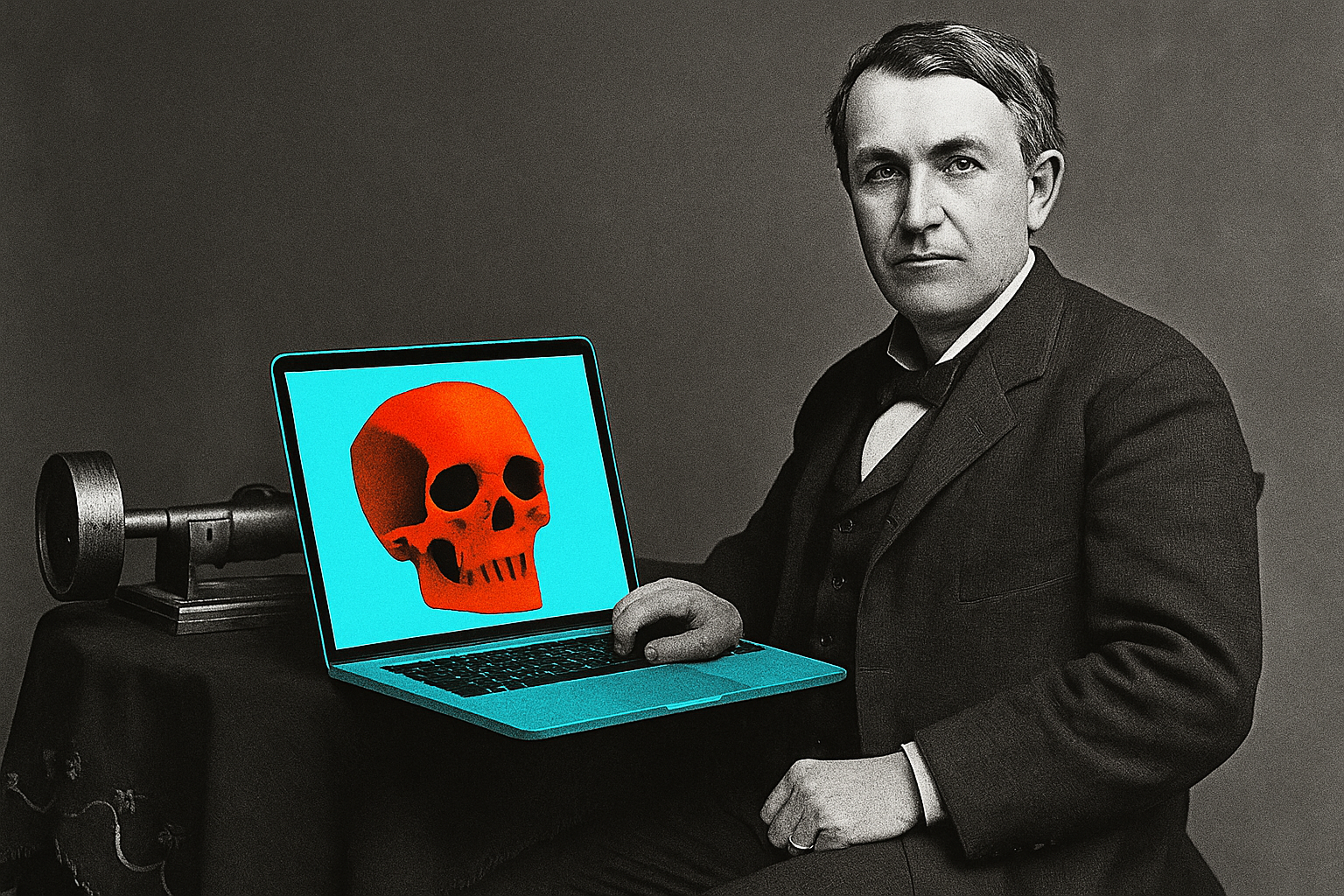
If someone offered you the chance to have one more conversation with your grandmother, would you take it?
On June 22nd 2022, Amazon hosted its Amazon re:MARS 2022: a series of keynote presentations “to get inspired, amazed, and educated on the latest in machine learning, automation, robotics, and space.” There, Rohit Prasad, SVP and Head Scientist for Alexa AI at Amazon, introduced a new innovation –framed by a screen with the words “Human-like empathy” emblazoned behind him:
“One thing that surprised me most about Alexa, is the companionship relationship we have with it. In this companionship role, human attributes of human empathy and affect are key for building trust. These attributes have become even more important in these times of the ongoing pandemic when so many of us have lost somebody we love. While AI can’t eliminate that pain of loss, it can definitely make their memories last. Let’s take a look at one of the new capabilities we’re working on which enables lasting personal relationships.”
The screen behind him changes, and you hear a young child’s voice, “Alexa, can grandma finish reading me The Wizard of Oz?” “Okay,” says the voice of the virtual assistant. The video jumps to a small boy reading the Wizard of Oz in bed, a broad smile on his face as his deceased grandmother’s voice issues from the small 4” by 4” ball on the side table, narrating—in a stroke of poetic surrealism—the Wizard’s monologue from behind the curtain.
This is by no means unique to Amazon, but represents a growing trend in application of AI technologies. In some instances, something like two-way dynamic communication is replicated through technologically mediated channels between one who has died and one who is still living. For the South Korean company “Deep Brain AI,” artificial intelligence is marshalled as a way to help persons grieve:
“Re;memory is a service using AI technology that allows the bereaved family to meet and talk with their loved one who passed away. We can help you to fulfill your wish to meet your family member who you miss but is no longer in this world. You can overcome the limitations of one-way messages such as recorded audios or videos of your loved ones, and communicate in both directions. The digital twins left behind by the deceased soothe the hearts of bereaved in the form of a new tribute. Bereaved families can maintain a bond with the deceased through AI.”
There is growing trend in AI technologies to facilitate and replicate communication with those who have died as if they were still alive. Of course, this isn’t altogether new.
In 1920, Thomas Edison famously declared intent to communicate with the “Next World.” Speaking of the potentiality of communication with life in the next world, Edison stated, “I believe that life, like matter, is indestructible. There has always been a certain amount of life in this world and there will always be the same amount. You cannot create life; you cannot destroy life; you cannot multiply life.”[1]
This may seem like the stuff of science fiction novels; more adaptable to an episode of Black Mirror than the mundane experiences of “real life.” Yet, it’s real; or, at least it’s really happening. Popularly labeled as “grief tech,” cutting edge technologies are being marketed as ways to cope with grief, preserve memory, and even “maintain a bond” with those who have died. It’s not surprising, therefore, that comparison with necromancy or resurrection has been used by many (see here or here).
But, what exactly is the difference between these sorts of applications of AI and necromancy—or Necromancy, at least, as the Bible defines it and as it existed in the ancient Near Eastern world?
In this essay, I want to explore the way that these technologies seek to mediate communication, and consider this communication in terms of intent and effect. I reflect upon some ways in which Artificial Intelligence is being utilized to enable us to cope with or otherwise mitigate the effects of death. I won’t pretend to entirely solve the larger ethical questions which issues like Ai churn up, but I do believe an argument should be made that the growing influence of secularization in forms of transhumanism and so-called “non-religious” spirituality have produced an environment where the line between life and death has become increasingly blurred. This has, in many many ways, enabled plausibility structures to emerge that permit practices that would have been unthinkable twenty years ago.
Now, there is a terminological problem that must be acknowledged at the outset. As an emerging technology, the term “Artificial Intelligence” is in definitional flux. As Kate Crawford observes in Atlas of AI, “‘machine learning” is the more common expression in technical literature. The technological and cultural idea of Artificial Intelligence is often spoken of in a similar manner to Justice Stewart’s infamous definition of “obscenity” in 1964, “I know it when I see it.” However, in terms of the general (and, admittedly, fuzzy) contours of what AI and machine learning is at present, we might say that AI is a form of non-organic (i.e. “machine”) intelligence that is designed to mimic organic behavior (that is, intelligent human behavior) in some sense.
The fact that AI has been defined in ambiguous terms has allowed the field to grow quickly and with limited circumspection. Arthur C. Clarke’s famous quip, “any sufficiently advanced technology is indistinguishable from magic,” is especially apt when we consider the blinding speed with which AI has developed. This is particularly so when we consider the growing application of AI to facilitate mimicked communication with those who have died. The comparison to magic and the occult is understandable—and the body of literature on this topic is growing quickly.
One only needs to listen to the actual developers of AI tech to notice the common theme of overcoming natural limitation. There is a sense that the world we live in is hostile to the world that we want to create, and that AI is a means by which we may usher in this world. Accordingly, when it come to the solving the problem of the separation of the dead from the living, there is a question that inevitably arises when we consider such applications: what exactly is the difference between such applications of AI and necromancy?
I. Three Possible Objections
I appreciate why this question is bound to raise eyebrows. It might seem absurd. Yet, we need to consider why it seems absurd and what assumptions might be at play. Indeed, several kinds of objections have and will be raised to the comparison of necromancy to such applications: 1) It may be objected that, unlike ancient practices of necromancy, such uses of AI do not enable us to actually speak with the dead. 2) Some might say that ancient practices of Necromancy—such as those mentioned in the Bible—were mystical and religious as opposed to the areligious and rational utilization of AI in this sense. 3) A third class of argument might be raised along the lines that this application presents the same mechanics of interaction that we might have in, say, looking at a photograph or watching a video of a loved one after they have passed.
To address these objections, it will be necessary to consider first what Necromancy is. I will do so first by examining necromantic practices in the ancient Near Eastern world, with brief reference to necromantic practices in cultures at large. Having established a relevant context, I will then examine several characteristic prohibitions of, and references to, necromantic practice in Scripture. Providing such a basis for examination, I will lay out some key components to necromantic practice that bear upon our consideration of certain applications of AI technology today.
II. Raising Canaan: Necromancy in the Ancient Near East
Perhaps the most well-known presentation of ancient Near Eastern Necromancy is in the 12th canto of Sumerian Gilgamesh epic where Enkidu’s ghost is summoned forth by Nergal at Gilgamesh’s behest: “Break open the chamber of the grave and open the ground, that the Spirit of Enkidu, like a wind, might rise out of the ground.” In this story, Enkidu’s ghost arises through a hole in the ground “like a wind” and proceeds to speak with Gilgamesh, bearing tidings of the nether world. This gives us some insight into how necromancy was presented in the popular imagination of those in Babylon.
Irving Finkel’s translation of two ancient Mesopotamian letters (BM 36703 and the neo-Babylonian K 2779, respectively) give us insight into Necromancy as it was actually practiced in the ancient Near Eastern world. In Finkel’s translation of the former, BM 36703, the conjurer is to speak first in Akkadian, and then Sumerian, with a precautionary exorcistic incantation lest the prescribed incantation “should accidentally summon the wrong entity.” Finkel continues on to consider what he calls “the clear necromantic material:”
Lines 11–61 contain the end of an Akkadian incantation addressed to Šamaš, with the intention that he, Šamaš, summon a ghost from (lit. of) the darkness. . . This ghost, once brought up from its place of rest, is then supposed to enter into a skull placed there for that purpose. The reciter of the incantation says: I call [upon you], O skull of skulls: may he who is within the skull answer me! There then follows in, in lines 7–10, a magical ritual that involves an oily preparation of animal parts being mixed up and left to stand overnight. It is then used to anoint either (lu) the skull (etemmu), or the NAM. [. . .], or the skull. At this point you call upon him and he will answer you (tašassišuma ippalka). In this context the word etemmu no doubt refers to a representation of the ghost and the ritual would have the same effect whether applied to this representation, to the NAM. [. . .], or to the skull itself. It is not quite certain whether all three elements were necessary. The idea, however, is quite clear. It is, quite appropriately, Samas who has the power and authority to bring up (sulu) a ghost from the Underworld, and the whole operation is put under his auspices. Somehow the ghost will enter into the skull, and answer the questions put to him.
Likewise, tablet K 2779’s first nine lines contain “exactly the same sequence of incantation, rubric, and accompanying ritual.” Furthermore, both sources require a magical concoction “quite worthy of Macbeth’s Three Witches:” “it is applied as an ointment to the eyes. According to BM 36703 then ‘then you will see the ghost, he will [speak] with you; you can look (at the ghost), he will [talk] with you.’ K 2779 merely says ‘you can look at the ghost, he will talk to you.’”
James George Frazer’s work Folk-Lore in the Old Testament considers a variety of instances of Necromancy across various times, places, and culture. Notably, Frazer considers most to be mere pageantry and chicanery. These stories are characterized by individuals seeking knowledge from those who have passed into the netherworld that is thereby kept from them in this life (e.g. knowledge of the future). Often the wishes of the deceased are communicated through a prophet or appointed medium: the spirit’s voice emanating from the mouth of an intermediary, using the intermediary’s own voice, or projected elsewhere in the room or ritual space.
III. Necromancy in the Bible
Reaching for Old Testament law governing the practice of witchcraft may seem a bit of as stretch to some—even a bit hysterical. And, of course, it’s not entirely inappropriate to think back to previous technological developments where concerned denizens cast technological development in vicious terms. It is, however, important to consider what texts mean in their context if we are to consider whether they have any bearing on the technological questions of our moment.
At this juncture, it’s helpful to contextualize the language of the Biblical prohibitions and stories of necromantic practice. To this end, I will briefly survey two biblical examples: the prohibitions of Leviticus 20 and Deuteronomy 18:9-11.
The first explicit biblical prohibition against necromancy occurs in Leviticus 19:31: “Do not turn to mediums or necromancers; do not seek them out, and so make yourselves unclean by them: I am the LORD your God.” It is again addressed in Leviticus 20:6: If a person turns to mediums and necromancers, whoring after them, I will set my face against that person and will cut him off from among his people.” Leviticus 20:6 stands in parallel relation to verse 27 within the chiastic structure of the chapter. Verse 6 deals with what will happen to those who seek mediums or spiritists: the one who does these things is cut off from the people of God, and the Lord promises that his face will be set against them. Verse 27 deals with what will happen to the mediums and spiritists themselves: they “shall surely be put to death. . .” Notably, verse 6 casts consultation with spirits in terms of prostituting oneself (זָנָה אַחֲרֵי), implicitly, against the LORD. Indeed, as noted by Milgrom, sexual immorality and Molek worship go hand in hand in the thematic grouping of chapters 18-20: sexual relations (18:6-20, 22-23), Molek worship (18:21), Molek worship (20:2-5), Sexual relations (20:9-21). In terms of the referent of “by them,” it would seem that it is the spirits that cause the wayward Israelite to be unclean. The parallel passages of 19:31 and 20:27 use the idioms בָהֶ֑ם לְטָמְאָ֣ה (to be defiled by them) and בָהֶ֥ם יִהְיֶ֨ה (is a medium for, or, lit. “has in them”) in reference to “the spirits.” Thus, it seems most likely that the referent in 20:6 is to the spirits rather than to the means of conjuring the spirits or the necromancers themselves. Thus turning toward these foreign elohim (as the dead are called in 1 Samuel 28:13) initiates what Milgrom calls “measure-for-measure” punishment: God will likewise turn away and against such a person.
This admonition regarding Necromancy is repeated in Deuteronomy 18:9-11: “When you enter into the land that the Lord your God is giving you, you shall not learn to follow the abominable practices of those nations. There shall not be found. . . anyone who practices divination or tells fortunes or interprets omens, or a sorcerer, or a charmer or a medium or a necromancer or one who inquires of the dead, for whoever does these things is an abomination to the Lord.” Notably, Deuteronomy cites these practices as grounds for divine judgment upon the Caananites (cf. vv. 9, 12). As with Leviticus 20:27, the holy status of the Israelites is underscored in Deuteronomy 18. It is to be preserved, undefiled by the surrounding nations. As Craigie observes, this admonition is couched in a wider discussion of Levitical ministry (vv. 1-8) and the prophetic deliverance of God’s word to his people (vv. 15-22). To practice such things is to go against the way of the Lord as ministrated by the prophets and priests of the LORD.
Israel’s holy status is wholly dependent upon the ways that the Lord provides Israel to be holy in the land: through the Levitical means of holiness, and by every word that proceeds from the prophet of the LORD. A rejection of divination, sorcery, necromancy, and the like, in this section is wholly appropriate when considered against Israel’s total dependence upon the word of the Lord. To turn toward another, as the magicians of Pharaoh (Exodus 7:11) or the wise men of Nebuchadnezzar (Daniel 2:2), is to turn toward another to mediate truth, life, assurance, and wisdom. At root, the sin of necromancy –as with the other sins listed here and in Leviticus 19 and 20 –seeks power and knowledge where the Lord has not appointed, and through means that the Lord has not granted.
IV. We Don’t Serve Spirits
Fundamentally, biblical references to Necromancy do so in the context of human attempts to interact with the spirits of those who have died. In context, the necromantic practices that are forbidden are overtly religious in tone: Israel was not to engage in the occultic and religious practices of their unbelieving neighbors. Yet, it would be a mistake to assume from this that therefore all attempts to communicate with the dead outside of an overtly religious and occultic context are therefore permissible. As we have seen, what is at root in the prohibitions of the laws concerning necromancy in Leviticus and Deuteronomy is not merely pagan worship, but a turning away from God and, by extension, life and death on his terms.
It’s important to note that Necromancy is not defined in the Bible according to the success of its rituals and practices. In other words, whether or not one speaks with a ghost or a real spirit is a relatively moot point. Scripture is clear that the souls of those who die go immediately to be with God (2 Cor. 5:8; Phil. 1:23; Rev. 4-6). They are either cast into eternal judgment or eternal blessedness in the presence of God. Accordingly, it would seem that claims of necromantic encounters must fall into one of two categories: 1) chicanery and trickery or 2) the activity of the demonic. There are no instances in Scripture of unbelievers or evil spirits bringing the souls of those who have died into the realm of the living. We do, however, have numerous examples of God’s resurrection of the dead in both Old and New Testaments (e.g. 1 Kgs. 17:17-24; 2 Kgs. 4:18-37; Matt. 27:50-53; Lk. 7:11-17; Jn. 11; Acts 9:36-43, 20:7-12). As such, it is not enough to say that applications of AI to mimic a conversation with the dead is different substantively from ancient practices where a spirit was truly consulted. Many of the instances of necromancy in the ancient world were chicanery. Yet, they were nevertheless forbidden. Likewise, we have no Scriptural grounds to say that demons have the power to bring souls up from the land of the dead: which is, in effect, chicanery of a demonic sort.
V. The Medium is the Messenger
No technology is necessarily wicked. The invention of bricks did not usher in divine judgment. Its technological development was not the cause of God’s judgment at the Tower of Babel (Genesis 11:7). Yet, those at Babel conspired to use the technology at hand as subordinate means to accomplish their wicked desires. Desiring to build a city with a tower that might reach into heaven, they believed that they could mitigate God’s curse: “Come, let us make bricks. . . Come, let us build ourselves a city and a tower with its top in the heavens, and let us make a name for ourselves, lest we be dispersed over the face of the whole earth” (Genesis 11:3-4). Likewise, frog intestines, skulls, and all other manner of items used to concoct potions and salves for the purpose of necromantic practice, are not in themselves evil. Yet, combined with intent to manipulate and break natural laws and appeal to evil spirits, or the souls of those who have died, is, in essence, to use them for nefarious ends. It is as though those who consult mediums and engage in necromantic practices say, “Come, let us apply ointment to our eyes and let us consult with the dead, that we might become as gods, controlling life and death.” The mode of necromantic inquiry, and the material used is relatively ancillary to the activity itself.
Scratch a rationalist deep enough, and we find mystical tendencies. Deeper still, and any non religious person will bleed a mysticism that is homo religiosus blood. There must be a retention, even in the most atheistic society, of a sense of religion. Indeed, even in a society where more and more look to technology as a means of reframing and resolving matters of pain and suffering, we cannot but do so in a way that is distinctly religious. As Alan Noble remarked, “Modern technology and modern faith are neither complements nor opposites, nor do they represent succeeding stages of human development. They are merged, and always have been, the technological enterprise being, at the same time, an essentially religious endeavor.” Thus, attempts to consider the utilization of AI in terms of communication with the dead and lessening the pain of loss as though it were areligious, are naive at best. To use the pun quite deliberately, the medium is the message. Indeed, the medium is itself a religious message signifying the religious values of the culture of the day.
Certainly, as McLuhan argued, medium and material shapes the action. Yet, the medium of frog gizzard ointments and human skulls likely says more about the cultural conception of life and death to ancient Mesopotamians than what Necromancy is in its essence. Importantly, the absence of these trappings –even the movement of the ceremony itself from the house of a witch into a hospital –does not mean that the act is any less forbidden. Across all instantiations of necromancy in Scripture, what appears to be common to all is 1) a desire to overcome nature and summon the dead, and 2) a refusal to submit to the God of the Bible as the sole Lord of the living and the dead. Just because a Medium isn’t present does not mean that there is not a medium being employed for necromantic purposes. The proposition that we are truly living in a time when modern rational inquiry has conquered the irrational mysticism of ancient peoples is suspect.
In the materialist system, the dead bring forth no tidings of the world beyond. They cannot. There is no other world; there is only what was and is experienced by the material of human existence. Whether or not a real spirit was brought forth is of no concern, for there is no such thing. Or, perhaps, we could never be certain that there was anyway. Instead, the dead may merely bring forth what is theirs according to the memories of their own life. Yet, this is all that AI may facilitate anyway. The various data points that are harvested from a person’s life –the video and audio recordings, written forms of communication, and other digital touch points with a person’s life and manner which may be collated and downloaded –are finite and material in nature. Algorithmic AI cannot generate something that is new, but depends upon the relevant data that it is provided. In such applications of AI, people are reduced down to memories or data about them that can be replicated, mimicked, and reproduced.As Gary Marcus argues, AI in its current form can only simulate the ability to reason: it cannot think abstractly, but only matches patterns. It cannot create the body, but AI can mimic the mind.
VI. Be Sure to Capture My Good Side
Though, what are we to make of photographs, or of voice or video recordings? If we are to draw a comparison between applications of AI and necromantic practice, then it would seem that we ought to be consistent. Indeed, we should. Yet, it would be wrong to say that such criticisms have not been so applied. Take for example the folk festivals of Mexico, such as Día de los Muertos. Altars are set up with sugared skulls and marigolds which help attract the souls of loved ones to the altar, along with bread, salt, and photographs of the deceased. It is held by many that the photos must be included lest their souls be kept from crossing over.
Photography is not wicked, but here again we see how disparate elements may be employed in a manner that seeks to control and manipulate the boundaries of life and death. Photography, music, and film are not evil in themselves, but like bricks they may be utilized in a manner that endeavors to overcome nature and the limits that God has placed upon humanity. Likewise, AI is not wicked. Indeed, in terms of potentiality, it would seem that one may replicate deceased loved ones in some manner without this replication being necromantic de facto. In a society where the boundaries between life and death are blurred, or otherwise ignored, the danger of trespass is all the more likely –particularly in an increasingly secular society.
VII. Conclusion
In modern society, there is an increasing trend toward a transhumanist conception of life where death is merely something that is to be overcome through technological evolution. So conceived, there is no trespass: “all that is solid melts into air.”
Applications of AI technology with an eye toward mimicking communication with the dead raises a host of ethical challenges. Among these, is the question of whether the lines between life and death are established by the medium, or whether the medium itself presents a kind of blurry half-way point between human life and human death. Furthermore, does the application of such technology aid or diminish our sense of real human, creaturely, dependence upon God as the sole Lord of the living and the dead? There would appear to be a distinction between offering comfort to someone who may have lost a loved one and denying the pain of sin, the curse of death, and the outright gulf of separation that exists between the living and the dead. Thus, in response to the question of whether such applications of AI necessarily constitute necromantic practice, we must reply “not necessarily so.”
Yet, we should not be blind to the fact that this medium may certainly be used with intent that is necromantic. As Christians, we understand that God alone may raise the dead –that, thereby, all attempts to supercede this ultimately amount to differing degrees of chicanery. To seek power and knowledge where the Lord has not appointed, and through means that the Lord has not granted, is wicked. God in Christ raised Lazarus from the dead as the Lord of life, and it is God who will one day raise the living and the dead to live, undying, forevermore. He is our one true comfort, in life and in death.
 Many Things
Leave a comment